I recently saw a video in which a bloke was explaining to the camera how he’d built a website in twenty minutes. He said it was possible, that he could teach others to do it too, and that if he’d commissioned the same thing somewhere else, they’d have charged him a lot of thousands for it.
I don’t know if it really took him twenty minutes – nor does it matter. Let’s say he’s right. Let’s say the website really is up and running in twenty minutes and looks presentable: the buttons work, it loads on a mobile, and there’s a logo and contact details.
And yet there’s a catch. Not the speed – that’s brilliant. The catch is that the word website 'Here' means two completely different things.
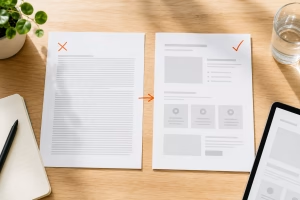
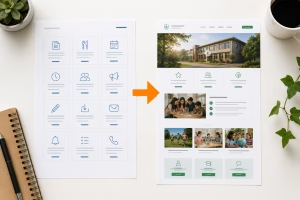
A website I’m looking at – and a website that actually does something. It brings in customers. It answers the right questions. It leads somewhere further. Those twenty minutes are spent on the first one. Someone was talking about ‘thousands’ for the second one. The mistake isn’t that someone chooses the cheaper option. The mistake is that they fail to realise that these aren’t two price lists for the same thing – they’re two different products.
What exactly did you pay?
Building a website has never been the expensive part. Anyone can click their way through a template these days, and it’s great that that’s the case.
Everything that happens is worth the time and money before you even start clicking: Who is this website for? What is the visitor looking to achieve when they visit it? Why should they choose you, of all people, rather than the other five companies that look almost identical? And what exactly should they do before they close the page?
The tool doesn’t ask you any of these questions. It builds exactly what’s in your head. And that’s the trap – you aren’t your customer. A website that makes sense to you is a website written for someone who already knows everything. For someone hearing about you for the first time, it’s often incomprehensible.
Where the problems lie
A cheap website rarely looks bad. The problems are almost always hidden – and only become apparent once it’s already cost you something.
A website with no purpose. It looks nice, but it doesn’t lead anywhere. Five links of the same size, no single clear call to action. Visitors take a look, nod their heads and leave. Nothing has happened, and you don’t even know why.
Texts from the vending machine. “Welcome to our website.” “We are a team of professionals with a personalised approach.” These words weren’t written by anyone who had your customer in mind. Yet on a website, words are almost the entire product – they’re what determine whether people will believe you or not.
A layer that cannot be seen. Speed. Measurability – do you actually know whether your website is working, or are you just hoping it is? SEO basics. A form that actually sends the email, rather than quietly discarding it. You won’t notice this until it starts costing you customers.
In half a year. Who will tweak it when you need a change? Who will fix it when something breaks? Can you tell from the figures what’s working, and do you know how to improve it – or do you just sit and wait?
When is a website built in 20 minutes the right choice?
And now for the most important bit, because otherwise this would just be another article by a professional who’s missing the boat:
Sometimes you just need the exact website you’re looking at. A simple business card. A landing page for a one-off event. A quick way to test an idea and see if anyone’s actually interested in it. In situations like these, a website built in twenty minutes is the right choice, and paying tens of thousands for it would be daft.
Skill isn’t about ‘always hiring a professional’. Skill is to work out which of the two things you actually need. And most people only realise this once the cheap website is up and running, looks good – and the phone isn’t ringing.
The website is almost never the problem
A website is usually just the answer to a question that nobody has actually asked out loud. Who are we selling to? Why us, of all people? What is the customer supposed to do?
A new website won’t solve these questions. It’ll just leave them unanswered, albeit in a nicer way. And it doesn’t matter at all whether it took twenty minutes or twenty hours to create.
That’s why I don’t start with the launch. I start with what’s supposed to work. The website is the very last step – the cheapest and simplest part of the whole process.