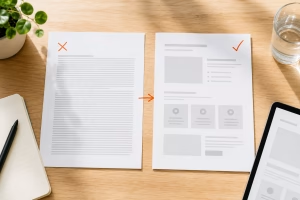
This is what I hear most often of all: “We’ve got a website and it’s really good.” And it’s usually true. It’s attractive, fast, easy to navigate, the photos look great, and it works well on mobiles.
The problem is that it’s good catalogue. And a catalogue, however good it may be, doesn’t sell. It merely showcases.
Imagine two shops. In the first, the shelves are perfectly organised, everything is labelled, the prices are clear – and there’s no one there. You walk round, have a look, and leave. In the second, there’s a sales assistant who’s full of energy. They read you, ask what you actually need, address even the concerns you haven’t voiced out loud, and get you excited – and you leave having spent your money and with a smile from ear to ear.
Most websites are that first shop. A sales website is the second. And it really doesn’t matter whether you’re selling products in an online shop or a service – this applies even more to services, because in that case the customer can’t touch the product; they simply have to trust what the website tells them.
The catalogue describes the product. The sales assistant will sort out whatever’s bothering you.
The catalogue lists the specifications, price and a photo, and that’s it. But the customer has completely different things on their mind, and they won’t voice most of them: Will it arrive on time? Will it suit me? What if it’s not quite right? Am I throwing money down the drain? How am I supposed to choose from those ten options?
A sales assistant will answer these questions – even the unspoken ones. The catalogue remains silent, and the customer leaves, saying they’ll ‘think about it some more’. Which means they won’t be coming back.
A catalogue is boring by its very nature. It’s the salesperson who’s the real star.
There’s no reason for a catalogue to be interesting. It merely lists products. But boredom is a silent killer – a bored customer will walk away and you won’t even know it. No click-through, no complaint – they’ll simply disappear.
A sales website has real bite. It has a voice, energy; it says things in a way that makes you want to keep reading. It’s not a circus or a shouting match – it’s life. The difference between a salesperson who inspires you and one who just points to the shelf.
The catalogue lets you decide for yourself. The sales assistant will inspire you to make a purchase.
The catalogue presents you with the information and leaves it up to you: make up your own mind. Most people, however, won’t make up their minds – decision-making is unpleasant, so they walk away. A salesperson will guide you towards that decision. They’ll dispel your doubts, show you why the purchase is the right choice, and make it a clear step to take. They don’t push. They guide.
The catalogue ends with a transaction. The sales assistant will see you off with a smile.
The job catalogue closes as soon as you’ve paid. But how you feel after The payment experience determines whether you’ll return and whether you’ll recommend the shop to others. A good salesperson will send you away feeling that you’ve spent your money well – not with that nagging thought: ‘Have I been ripped off?’. That ear-to-ear smile after a purchase is worth more than the purchase itself.
Why a good catalogue is the most expensive trap
Because it looks like a success. It’s finished, it looks good, everyone’s nodding in approval, the invoice’s been paid. And it isn’t selling – and nobody knows why, because ‘it’s a good one, after all’. An ugly website that doesn’t sell will be fixed by someone sooner or later. A beautiful catalogue that doesn’t sell just quietly drains your money year after year, money you never even noticed was slipping away.
That’s why it’s not about having a prettier website
My job isn’t to produce a prettier catalogue. Anyone can produce a pretty catalogue these days. It’s to turn the website into a salesperson – someone who engages with the customer, addresses their concerns, keeps them interested and inspires them to make a purchase.
A website that simply exists, versus a website that’s dynamic and makes money. That’s the whole difference. And it doesn’t start with how it looks – it starts with what it’s meant to do.