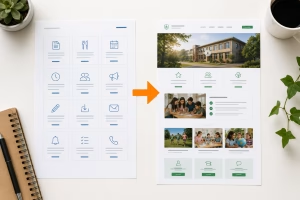
Do you need a new website or a revamp of your current one? You receive three quotes. They all look professional, and they all promise a modern website and better results.
What should you base your decision on? Neither the price nor the deadline will give you the answer.
The difference between suppliers isn’t about who builds the website. It’s about who identifies in advance what actually needs to be changed and why. The following seven questions will highlight that difference in the space of a single meeting.
1. What specific problem is the new website or proposed change intended to solve?
Is the problem with the website’s design, visitor numbers, an unclear range of products or services, a lack of trust, or the fact that visitors don’t take the next step?
Why ask: An outdated look is not, in itself, a business problem. The supplier should be able to explain what the project is set to change for your customers and for the company.
Be on your guard when: The main reason given is simply that the current website is outdated or that the competition has a more modern one.
2. How do the right people find their way to the website?
Does the design focus solely on the website itself, or does it also take into account where your customers will come from?
Why ask: Even a well-designed website won’t bring in business if nobody knows about it. Depending on the sector, the solution might be search engine optimisation, advertising, content, word of mouth or active sales.
Be on your guard when: The supplier promises more enquiries simply because of the new design, without taking any interest in your current visitor numbers or how you currently attract customers.
3. What makes you think that’s where the problem lies?
Does the supplier base its findings on GA4, Microsoft Clarity, business data, customer interviews, user testing, or simply on expert judgement?
Why ask: An expert opinion is important, but it is not the same as evidence. The supplier should distinguish between what the data show, what can be directly observed, and what is, as yet, merely a hypothesis.
Be on your guard when: He presents every recommendation as a certainty, even though he has no data or other evidence to back them up.
4. What are we measuring today, and how will we know in three months’ time that the change has helped?
What is the baseline situation, which results will we be monitoring, and who will ensure that the measurements are set up correctly?
Why ask: Without knowing the baseline, it is impossible to say with any certainty whether the change has led to more enquiries, orders or improved website engagement.
Be on your guard when: Success is described in terms such as ‘the website will be more modern’ or ‘it will look better’. This cannot be assessed.
The verification method varies depending on the size of the business:
- Sometimes an A/B test makes sense,
- in other cases, a comparison of the situation before and after the change,
- sometimes user testing,
- For low-volume operations, a qualitative analysis of behaviour in Clarity.
A supplier that offers A/B testing for every project, regardless of traffic levels, is merely using the term for show. On a website with low traffic, the test will run for so long that the results will be unusable.
5. Which part of our brief would you try to talk us out of?
Why ask: An expert’s role is not simply to tick off a list of requirements. They should highlight any changes that are unnecessary, premature, too expensive or likely to make the situation worse.
Be on your guard when: The supplier will agree to every request without reservation, without asking why you want it or what it is supposed to achieve.
6. What will you need from us, and how long will the project take us?
Who will prepare the texts, photographs and supporting materials? Who will make the decisions, and how quickly do you need to respond?
Why ask: Web projects most often don’t get held up by the programming, but by missing text, unclear decision-making and a lack of time on the client’s part.
Be on your guard when: The quotation includes the supplier’s price and delivery date, but it does not specify at all what you are required to supply or who is responsible for the individual parts.
7. What exactly will we receive, and what will we be left with once the collaboration has ended?
Make sure you understand:
- specific project outputs,
- source files and documentation,
- domain and hosting,
- web, analytics and advertising approaches,
- measured data,
- licence,
- further support and the option to transfer the website to another provider.
Why ask: You need to know not only what will be produced, but also whether you will have your own access and the opportunity to work on the result further.
Be on your guard when: Domain, analytics and advertising accounts are set up in the supplier’s account, and it is not clear how you will take them over later.
Summary
A good offer doesn’t start with a list of features or a new look.
The supplier should first explain what the likely cause of the problem is, what their reasoning is based on, how customers find their way to the website, what they recommend doing first, and how you can work together to determine whether the change has helped.
These questions apply both to a new website and to modifications to an existing website or online shop.
Would you like to know how I answer these seven questions in my own work? Take a look at My approach to improving websites and online shops.
Are you planning a new website or an update to your current one? Download the questions in a one-page format and use them during a meeting or when comparing quotes.