The web doesn't often lose customers by being ugly. It loses them by not giving them enough security.
Maybe you know it. You have a website that doesn't look bad at first glance. The services are described, the contact details are visible, maybe you have references, photos of implementations or a few sentences about why to choose you.
Still, there are not as many inquiries coming from the web as you would expect.
At a time like this, it's easy to say to yourself:
"I think we need a new design."
"Maybe the website doesn't look modern enough."
"Maybe we need to invest more in advertising."
"Maybe people are too expensive / cautious / indecisive."
Sometimes that can be true. But often the problem is elsewhere.
People don't have to leave because they don't care about your service. They may leave because they don't find enough reasons to take the next step during their visit.
The demand does not arise until the form
A lot of companies only address the web the moment a person clicks on the "Contact Us" button. But the decision to write to you comes much earlier.
From the very first screen, the visitor is already composing answers in his head:
- Is this for me?
- I see, what exactly are you offering?
- Do I understand why I should choose you?
- Do I trust you?
- Do I see any evidence?
- Do I understand what happens after I send the request?
- Won't it be expensive, complicated or binding?
- Is there any reason for me to take the next step now?
If the website does not answer these questions, one often does not come away with a clear "no".
He'll leave feeling..:
"I'll look elsewhere."
"I don't have time for this right now."
"I don't know if it's for us."
"Maybe I'll come back to it."
And they usually don't come back.
A nice website can still leave a person insecure
Design is important. It helps create a first impression, credibility and clarity. But it's not enough on its own.
A website can be modern, clean and visually pleasing - and yet it may not explain well:
- who the service is for,
- what problem it solves,
- why it is different than similar offers,
- what result the customer can expect,
- why she should trust you,
- what to do as the next step.
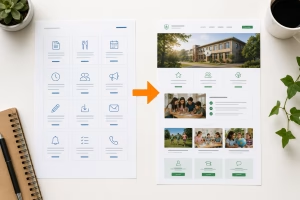
This is why redesign alone often does not solve weak demand.
If you just change the look and feel, but leave a vague menu, generic text, weak evidence and unclear CTAs, the site may look better - but it still may not perform better.
A new coat won't solve the customer not knowing why they have to move on.
Where demand is most often lost
Demand is rarely lost in one place. It is often the sum of smaller uncertainties.
1. It is not quickly clear who the site is for
The visitor should understand within a few seconds if he is in the right place.
A general sentence like:
We offer quality services with an individual approach.
is usually not enough.
It's better to show them specifically:
- who you're helping,
- with what,
- what kind of result he can expect,
- in which situation you are a good choice.
If one does not know oneself, there is no reason to continue.
2. The offer is described too generally
Many websites describe the service in a way that could be used by competitors.
Quality. Professionalism. Experience. Individual approach. Tailor-made solutions.
It may all be true. But the customer often doesn't know much more after these sentences than before.
He needs specificity:
- What exactly will you do for him?
- How does the cooperation work?
- What problem does that solve?
- What does he get at the end?
- What will change as a result?
The general offer creates uncertainty. A specific offer helps the decision.
3. Lack of reasons to trust
The references on the web are good. But a logo or general praise alone is often not enough.
It is more powerful when the customer sees the context:
- who you've helped,
- what was discussed,
- why it was important,
- what the output was,
- what's been clarified or improved as a result.
A reference without context says:
Someone was working with us.
A reference with context says:
We can solve this and here is concrete proof.
And that makes for much stronger decision-making.
4. The website does not handle objections
Visitors are often afraid to inquire about things that are not named on the site at all.
For example:
- How much will it cost?
- Won't someone force me into a big project?
- Is it for a company our size?
- What if I don't know exactly what I need yet?
- What if we have an old website or template?
- How soon will I hear from someone?
- What happens after I submit the form?
If the web does not address these concerns, one must address them themselves. And that often means doing nothing.
5. CTA tells you what to do, but not why
The "Contact Us" button is technically OK. But that alone may not be reason enough to click.
One needs to know:
- why he should write,
- what he's gonna get,
- what happens next,
- if it's binding,
- if they have to have everything ready,
- when he can expect an answer.
The difference is between:
Contact us
and:
Send me a link to the site. I'll get back to you with a suggestion if a quick assessment or other next step makes sense.
The second option reduces uncertainty. And that is often exactly what the visitor needs.
The web is supposed to lead a person to a decision
A good website is not just a place where information about a company is displayed.
It's a decision guide.
It helps a person go from the first question:
"Is this for me?"
to a decision:
"It makes sense to write here."
This doesn't mean that the site has to be long, aggressive or cluttered with arguments. On the contrary. Often you just need to better piece together what you already have on the web.
But it must be clear:
- who you're helping,
- exactly what you're offering,
- why a man should trust you,
- what the next step is,
- what happens after that,
- why it makes sense to act now.
When it makes sense to assess the page
A quick site assessment makes sense especially when:
- the website doesn't look too bad, but the enquiries aren't coming in,
- you're going to redesign and you don't want to just guess what to change,
- you send traffic to the site from ads, social networks or referrals,
- not sure if the page explains the value of the offer well,
- you want to know what to edit first,
- you don't want to tackle the whole website right away, but you need a specific view of one important page.
You don't have to redesign the whole site right away. Sometimes you just need to start with one key page and see where it loses trust, clarity, or the next step.
Summary
A nice website is a good start. But it's not enough.
If a website is to generate enquiries, it must help people make decisions. It needs to give them clarity, confidence and reasons to take the next step.
People often don't leave because they are not interested in the service. They leave because they are not sure.
And uncertainty is often the biggest obstacle on the web.