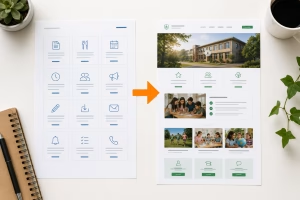
A school website is often created with a good intention: to give parents information. Timetables, menus, documents, contacts, news, photos of events, registration, school rules.
It's all important. The problem is when the web just stays there.
Then, although it fulfils the function of an information board, it does not fulfil a second, increasingly important role: to help parents understand why this particular school might be a good choice for their child.
And that's the difference.
Parents are not just looking for information. They are looking for reassurance.
When a parent chooses a school, he usually does not only deal with practical data. He doesn't just ask:
- When is the enrollment?
- Where can I find the application form?
- What is the contact information for the Secretariat?
- Where's the menu?
There are other questions running through his mind:
- Will my child feel comfortable here?
- What is the attitude of the teachers?
- Is the school safe?
- Will the child develop or just "somehow pass"?
- How does the school communicate with parents?
- Is it a school for us?
These are questions that a regular bulletin board doesn't answer.
This is where the school website can play a much bigger role.
Open Day is not enough
Schools often rely on open days. This is certainly important, but there is one catch: it is usually attended mainly by parents who are already thinking about the school.
The website has the ability to reach parents earlier.
Yet at the moment they are only fleetingly comparing the school. When they're looking for options. When they're asking friends. When they're not sure what to choose.
A good website is therefore not just to inform those who have already decided to come. It should also help to attract those who might not have thought about the school without a good presentation.
School website or website for parents?
I think that's a crucial difference.
Many school websites are built as school website. From the point of view of the institution:
- what we need to disclose,
- what documents we need to have online,
- what events have taken place,
- what information to give to parents.
But the parent comes with a different perspective. He needs to orient himself, gain trust and understand what is important to him and his child.
Therefore, it makes more sense to think of the web as website for parents.
Not just "what we want to say", but more importantly:
- what the parent is dealing with right now,
- what he's afraid of,
- on which to make a decision,
- what he needs to see,
- to help him take the next step.
The school does not have to look like a commercial company
When people say that a school should do a better job of "selling" its offerings on the web, it may sound inappropriate. After all, a school is not an e-shop.
But it's not about aggressive marketing. It's not about advertising phrases or empty slogans.
It's about the school being able to show in a clear way:
- what kind of access he has to children,
- where she's strong,
- for which children and parents it can be a good choice,
- what a typical day at school looks like,
- how communication with parents is handled,
- how the school works with the atmosphere, safety and development of the children.
That's not manipulation. That's good communication.
Parents make decisions anyway. The question is whether the school will help them on the web or leave them floundering.
What is often missing on the school website
The problem with school websites is often not that they don't have enough information. Rather, the problem is that the information is not put together according to the parent's decision.
Typically missing:
A clear introduction to the school
Not a general sentence like "we are a modern school with an individual approach", but a specific explanation:
- what it means in practice,
- how that translates into teaching,
- how a parent knows,
- how a child experiences it.
Content for parents of future first graders
Parents before enrolment deal with different things than parents of children who are already in school.
They need to know how enrolment works, what the child should know, how the school works with adaptation, what happens after admission and what the start of the first grade is like.
Reasons to consider the school
Not as a list of marketing slogans, but as concrete arguments:
- smaller collectives,
- strong community,
- safe environment,
- good communication,
- experienced team,
- clubs and activities,
- Supporting both weak and gifted children,
- continuity with further education.
Each school has different strengths. The website should be able to name them.
Real-life examples of school life
Photos from events are fine, but often not enough. A parent needs to see the atmosphere and context.
They work well, for example:
- short stories from the classes,
- examples of projects,
- teacher introductions,
- explanation of teaching methods,
- answers to common questions,
- a sample of a child's daily routine.
A clear path to the next step
If parents are interested in enrolment, an open day or a visit to the school, they should not have to do a complicated web search.
A good website should clearly lead the way:
- want to get to know the school?
- are you interested in enrolling?
- you wanna come see?
- Do you have a question?
And at each step it should be clear what happens next.
A better school website helps the principal too
Principals and school leaders often deal with promotion but do not have the time or experience to do marketing systematically.
The web can be their mainstay.
They don't have to do ads, campaigns or complex social networking right away. A website alone can do a much better job of explaining who the school is for, how it works, and why it makes sense to consider it.
A good school website then helps:
- to better introduce the school to parents,
- to reduce repeat enquiries,
- to encourage enrollment,
- to show the school's strengths,
- to attract parents who share the school's values,
- to build trust before the personal visit.
So it's not just about the look of the site. It's about the website helping the school communicate value.
Information board is not enough when parents choose
The information board is good for parents who already know the school.
But for parents who are still deciding, it's not enough.
They need to understand why they should trust the school. They need to see the approach, the atmosphere, the specific reasons and the next step.
The school website should therefore not just be a place where documents and news are stored.
It should be one of the main tools for the school to show who it is, who it is for, and why it is worth paying attention to.
Want to know if your school website is really helping parents?
I can look at one key page of your website and show you where it loses clarity, confidence or the ability to guide parents to the next step.
As part of a quick site assessment, you will be given specific recommendations on what to improve so that the site is not just a bulletin board, but actually helps the school communicate better with parents.